Hello! As part of a project involving a computational pipeline for signature extraction and analysis in historical Chinese contracts, we are looking for some help in assigning human judgments to around 500 signatures which we have linked to individuals in a genealogy of the Que lineage in Shicang village, Zhejiang. A comprehensive set of human labels may assist with supervised machine learning, and provide insights into the relationships between signatures, literacy, and social groups. If you would like to help, please continue reading.
For context, measuring literacy in early modern China is quite difficult. Past studies—which have drawn on a variety of materials, including government proclamations, market reports, popular fiction, character books or reading primers, household account books, recipes, and other sources—generally propose a “continuum” of literacy with classical Chinese mastery, attained through studying for the civil examinations, on one end and full illiteracy on the other. However, scholars have been unable to arrive at a consensus on the specifics.
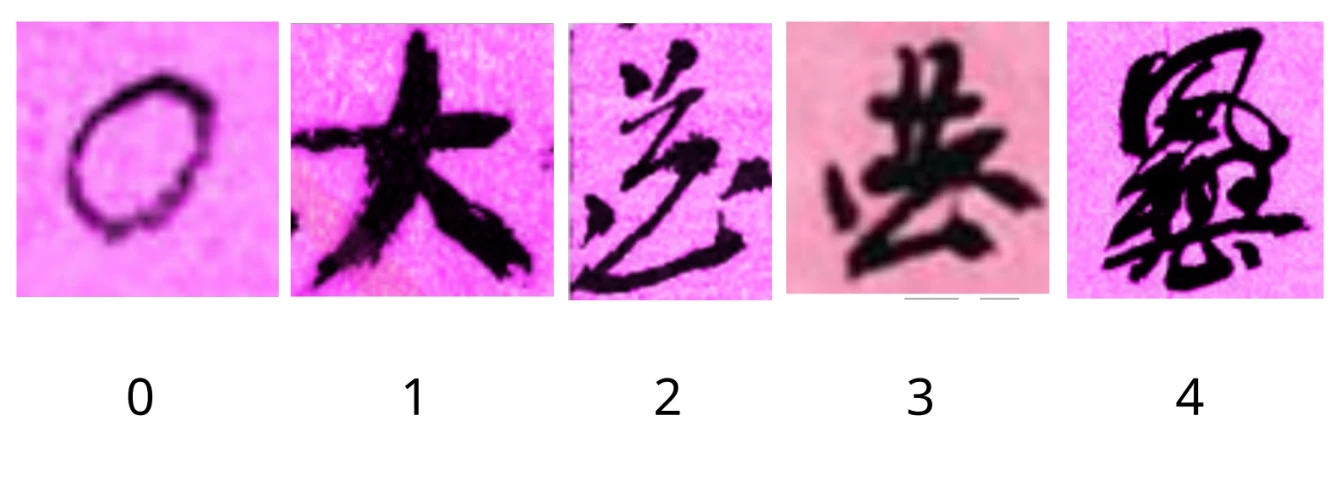
To make observations about the literacy spectrum, this project is interested in looking at signatures as evidence for literacy and writing skill. Before the popularisation of seals, it was signatures, or huaya, which enabled individuals to prove the legitimacy of their claims, as they offered a means for individuals to verify their identity on a variety of documents from land transfers to marriage contracts, with illiterate individuals often signing with circles or crosses. Though signatures were often formed from sections of Chinese characters and followed different styles of marks, they reflected a range of unique personal quirks and traits, among which may include literacy level.
But just how reliable are signatures as a proxy for literacy? Though signing ability has been linked to intermediate levels of literacy by Roger Schofield and David Cressy, it is unclear how signing ability relates to the lower end of writing ability. In addition, Evelyn Rawski notes that though historians of Europe may rely on signatures as a rough measure of literacy, the non-phonetic nature of the Chinese script renders signature data less reliable. Nevertheless, as Richard Rubinger and Liu Yonghua have shown, given the complexity of Chinese characters, the level of dexterity required to handle the ink brush, and the significance of signatures in legal verification, historical Chinese signatures or monograms remain a valuable, if mildly opaque, window into literacy.
Because a significant link between signatures and literacy is the ability to wield a brush, for the purposes of this project we can define fluency as clarity and precision in writing, which may be more obvious in complex signatures (but is not necessarily the same as complexity since, between two non-complex signatures, one can be more fluent than the other), as seen in the chart above. Feel free to refer to it when making your own judgments!
Thank you for reading! Please fill in some information about yourself before proceeding to the ranking. At the top of the page, you can toggle between modes: the “rank” mode shows two signatures and has you evaluate which looks more fluent and the “rate” mode shows one signature and has you evaluate its fluency on a 0 to 4 scale. Feel free to choose whichever mode seems more doable, or both. Finally, your progress will be saved automatically, so do not worry about leaving and coming back. You may finish or leave the tab at any time. There will be a small surprise for those who have completed 100 ratings.